Turning Biology Into Economic Value
Fertilizer prices remain one of the most unpredictable (and costly) inputs in modern agriculture. For many growers, the challenge isn’t just volatility, but access. A recent nationwide survey found that a majority of farmers say they may not be able to afford all the fertilizer they need this season. In that environment, crops that reduce dependency on purchased inputs are more valuable than ever. Alfalfa is one of them.
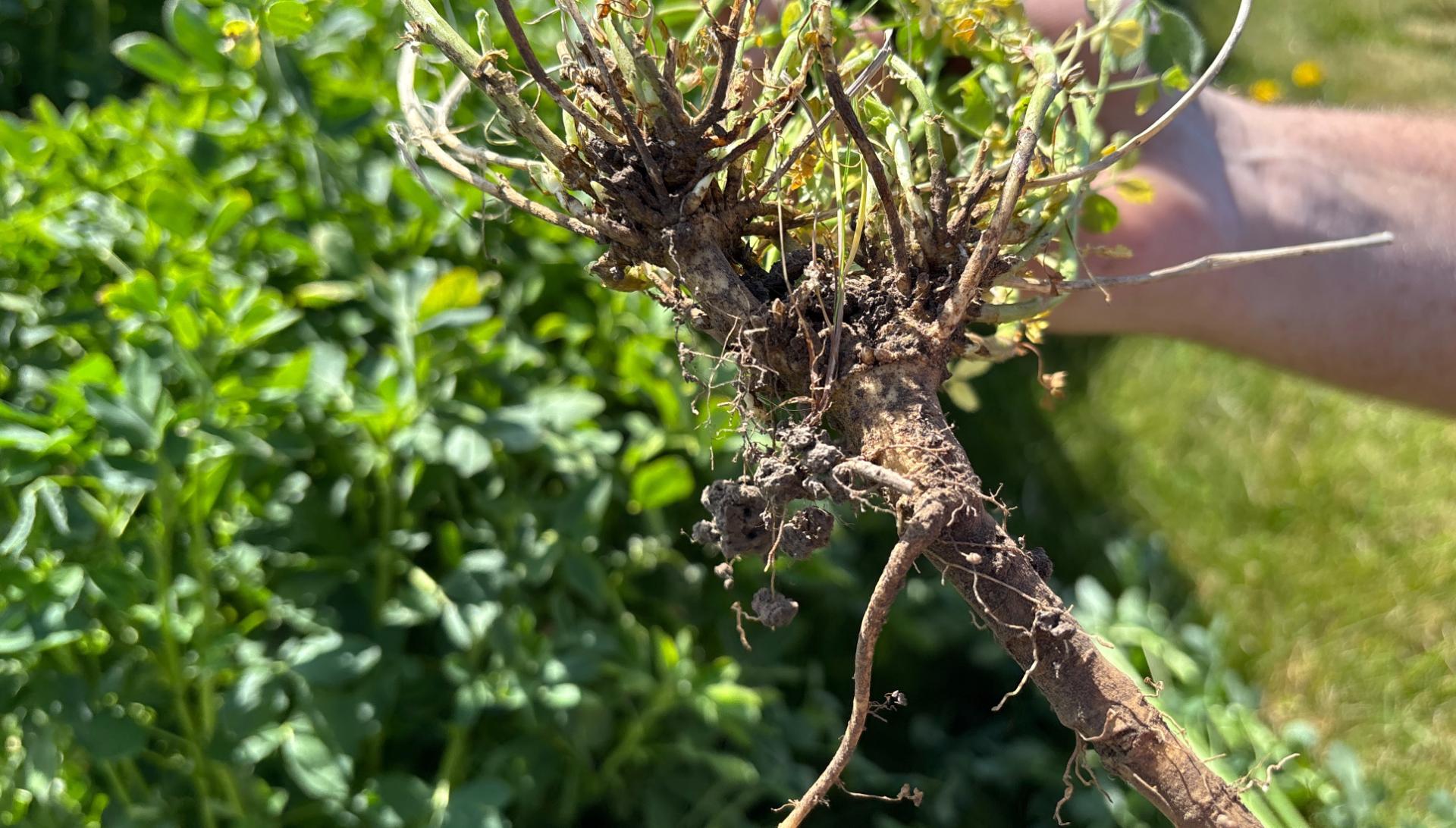
How Alfalfa Fixes Nitrogen
Alfalfa is a nitrogen fixing legume, which means it has a unique ability to generate its own nitrogen through biological nitrogen fixation.
This happens through a symbiotic partnership with Rhizobium meliloti bacteria:
- The specific bacteria infect roots and form nodules
- Inside those nodules, atmospheric nitrogen (N₂) is converted into plant‑available nitrogen
- The plant uses that nitrogen for growth and regrowth after each cutting
- In turn the plant creates, via photosynthesis, sugars which is a food source for the bacteria

Because of this system, established alfalfa stands typically supply the majority of their nitrogen requirements internally and rarely require fertilizer nitrogen. Recent research continues to support this, showing that alfalfa can derive a large share of its nitrogen directly from the atmosphere under low-fertilizer conditions.
For growers, that means:
- Lower fertilizer inputs during production
- Reduced exposure to nitrogen price swings
- Greater efficiency when nitrogen applications are limited
Nitrogen Stored and Reused
What makes alfalfa especially valuable is what happens after the stand is terminated. Over time, alfalfa builds nitrogen into:
- Root systems and crowns
- Aboveground biomass
- Soil organic matter through root turnover
As these materials break down, nitrogen is released into the soil and becomes available to future crops. This creates a nitrogen reserve for the next crop – commonly referred to as a nitrogen credit.
Recent USDA and university research confirms that nitrogen from alfalfa residues continues to be released over time, supplying crops not just in the first year, but often beyond.
Key findings include:
- First-year corn following a healthy alfalfa stand can receive up to 150 lb. N per acre
- In some cases, no additional nitrogen fertilizer is required to achieve full yield potential
- Second-year corn often benefits from an additional 50–75 lb. N per acre
- Some field trials show no measurable yield response to added nitrogen even into the second year
Recent and ongoing research continues to validate these patterns, with current studies focused on refining nitrogen credit recommendations across different soils, climates, and management systems. These trends have been documented by land‑grant universities including Minnesota, Wisconsin, and Utah State, and supported by long-term field trials.
The Economic Value of Nitrogen Credits
When fertilizer prices are high, nitrogen credits become even more important. Research-based examples show:
- A 150 lb. N per acre credit can reduce nitrogen costs by approximately $60 to $80 per acre depending on fertilizer type
- Second-year credits can extend that value across multiple seasons
- In some systems, nitrogen credits can significantly reduce (or eliminate) the need for applied nitrogen
When combined with stable or increased yields, these savings contribute directly to improved profitability. In some cases, research has also shown that crops following alfalfa benefit from improved productivity, further strengthening the economic return of the rotation.
For example, recent research highlights that alfalfa:
- Improves soil structure and aggregation
- Enhances soil organic carbon and nitrogen cycling
- Reduces nitrate leaching potential in long-term systems
- Lowers weed, insect, and disease pressure
- Increases yield potential compared to less diverse rotations
What Affects Nitrogen Credit Realization?
Although nitrogen credits are well established, they are influenced by field-level conditions. Understanding these factors helps growers capture the full value of alfalfa.
- Stand Health and Density - Healthy, productive stands generate more biomass and contribute more nitrogen.
- Nodule Activity - Nitrogen fixation depends on active nodules. Healthy nodules are typically pink inside, indicating active nitrogen fixation.
- Timing of Termination - Nitrogen availability depends on when alfalfa is terminated relative to the next crop.
- Soil and Environmental Conditions - Soil texture, moisture, and temperature affect decomposition and nitrogen release.
- Soil Testing - Soil testing remains critical to determine how much nitrogen is available and fine-tune fertilizer decisions.
A Strategic Tool for Managing Input Costs
Alfalfa offers a unique combination of agronomic and economic advantages:
- It replaces purchased nitrogen with a biological system
- It contributes nitrogen to future crops
- It improves soil health and nutrient cycling
- It reduces exposure to volatile fertilizer markets
For growers facing rising input costs, alfalfa continues to prove its value. This is one reason we love alfalfa. Explore more research-backed insights at WeLoveAlfalfa.com.
REFERENCES
University of Minnesota Extension. Nitrogen management for corn following alfalfa (2024–2026) - guidance on nitrogen credits and fertilizer requirements in rotation systems.
University of Wisconsin Extension. Nitrogen credits for alfalfa and soybean - recommendations for first- and second-year nitrogen availability following legume crops.
Utah State University Extension. Crop response to nitrogen following alfalfa - research on reduced nitrogen fertilizer requirements and rotation performance.
USDA Agricultural Research Service. Alfalfa nitrogen fixation and transfer research (2023) - findings on biological nitrogen fixation and nitrogen availability in cropping systems.
University of Nebraska–Lincoln Extension. Benefits of including alfalfa in rotations with annual crops (2023–2024) - research on nitrogen cycling, reduced leaching, and soil health impacts.
Minnesota Corn Growers Association Research. Evaluating nitrogen credits following alfalfa (2024–2026 ongoing) - current studies on nitrogen credit variability across soils and management systems.